AP Hockey Story of the Day: October 23

Craig Custance has a great (unfortunately insider only) piece on coaching salaries in the NHL, and Mike Babcock’s stand for his fellow coach. It’s a very interesting read.

The biggest reason why hockey is so in need of a catch-all stat isn’t for basic analysis, because combining different metrics isn’t so hard, but it’s so that there’s a baseline for salaries. Being able to say that Bryan Bickell adds 2.4 wins per season above replacement but Joel Quenneville adds 3 would be huge, and would affect salaries in a big way, equivalent to what has happened at the GM level in baseball.

AP Hockey Story of the Day: October 22

Considering that a large part of what I use twitter for is finding great things to read, and then to tweet them out to my followers, I’ve decided to streamline this process a little bit. Considering that some of my analytics work (but don’t worry, not all) will be transferring to Hockey Prospectus, I’ve decided to pick a piece of writing, every day (okay probably not every day) that I believe to be truly great. This could be a work of analytics, something conceptual, it doesn’t even necessarily have to relate to sports, although it most often will. Instead of posting said piece on twitter, I will post in hear under the headline “AP Hockey Story of the Day” and, time-willing, will offer some brief thoughts on the piece.

So long story short, if you like reading the types of articles I tend to tweet out, make sure you either visit the blog frequently, or at the very least keep tuned to my twitter account as I tweet out links to these pages each day.

Continue reading

The Deployment Dilemma: How Fourth Lines Can Maximize Team Output

The season is finally here, which is great for most of us. But for some young up-and-coming players, it means getting cut from NHL rosters (whether now or following brief tryouts) while players who nobody would argue possess equal skill occupy the league’s fourth line spots. It’s an interesting dilemma, and one that until now nobody has to my knowledge managed to quantify. I’m only going to take the first step here, and speak in very broad generalities, but I hope that this piece will frame the debate over the use of the fourth line a little better, and present some evidence that maybe it’s time for change.

But first, a little perspective. Hockey wasn’t always about toughness or grit. In Canada, hockey’s roots lie in lacrosse, where early Canadians sought to find a winter alternative to their favored summer pastime. They implemented elements of rugby (like the no-forward pass), which certainly brought an element of ruggedness to the idea, but keeping the puck – or in the earliest days, ball – was basically as important as it’s seen to be by analytic types today. In Russia, meanwhile, hockey developed from soccer. Possession there was also critical, and simply speaking the best players played. There wasn’t much need for pests, or rats, or whatever you want to call them. It would have been out of character considering the sport’s origins.

Continue reading

On Zach Parise, Players Using Analytics, and Healthy Skepticism

There’s a show called Modern Family in which a couple adopts a child named Lilly. The show plays up the little girl’s typical curiosity, as at varying points she’ll go into a phase where she just asks “why” continually until her parents get fed up. For some reason I thought of that while reading this piece by the Star Tribune’s awesome Minnesota Wild columnist Mike Russo this morning. Parise has always been one the players I have most admired because I think he blends the old school abilities to work hard, go to the net, block shots, and play in all situations, with the more new school skills at puck handling, entering the offensive zone with control, and most importantly, scoring goals. I may be Canadian, but even I could appreciate how cool his game tying goal in the 2010 Olympic Gold Medal Game was (and let’s just not forget how that game ended).

Continue reading

On whether analytics are useful to players

There have been some interesting (let’s be honest, ridiculously annoying) quotes recently on the acceptance of analytics amongst coaches and players. “Of course coaches should use it,” the popular refrain goes, “but I don’t think players themselves can take much use from it directly. Well this interview between FanGraphs and Oakland A’s outfielder Brandon Moss suggests otherwise. Give it a skim and take note of how Moss’ awareness of in what situations and under what conditions he has success influences choices he makes with regards to his technique and strategy. Sure, it’s easy to say that coaches should look at the numbers and then relay general concepts to the players, but with that approach you’re opening yourself up to the same problems in acceptance as you are bringing general concepts to GMs without numbers to back them up.

Continue reading

On whether descriptive, non-predictive stats really have use

As many of you know, I love reading about baseball and soccer analytics. I think that in baseball’s case, having the “first mover” element means that later-adapting sports like hockey can look to copy many of their concepts and ideas, even if the sports are quite different. Soccer, meanwhile, is quite a similar game to hockey – just a slower version – and therefore many of the more specific practices translate quite well.

Soccer is at an interesting point though because they, unlike baseball, are uncovering new statistics (courtesy of companies like Opta) while also just now figuring out which of those statistics are meaningful. You can get an idea of how far behind analytics in soccer is by the fact that its main predictive statistic: Total Shots Ratio – which is essentially the soccer version of corsi – is actually based on corsi.

Continue reading

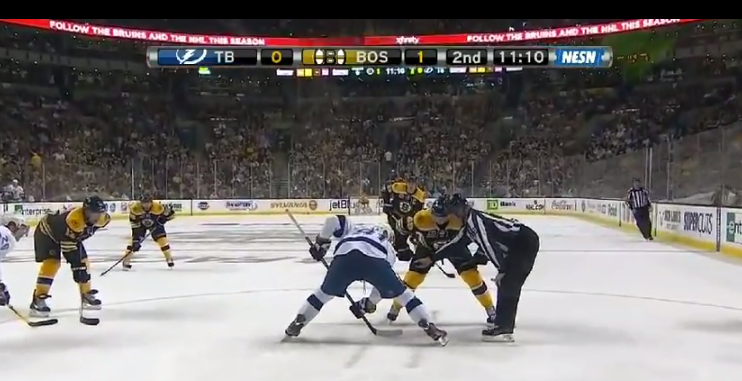
Controlled Situation Corsi: Patrice Bergeron, David Krejci, and the Set Play

Screen Shot 2014-09-09 at 7.01.06 PM

I wrote last week about the Bruins’ struggles following offensive zone faceoff losses. Obviously, Shawn Thornton played a part in that, but a fourth line can only get so much ice time, and obviously there was a bigger issue. When I looked over the numbers from the past few years, it became clear that David Krejci and his linemates, who received a large portion of the offensive zone starts, were hurting the team the most in those situations. Considering Krejci’s new 6 year, $43.5 million contract, and the ongoing debate over whether he or Patrice Bergeron is truly Boston’s number one center, I decided to look briefly (update: not so briefly) at the breakdown of their numbers and where such struggles might be coming from. First of all, here are the numbers.

Continue reading

On Martin Brodeur, “GOAT”, and Longevity

There was a report published today that the Montreal Canadiens have, or had, or might have had interest in Martin Brodeur as a backup goalie to Carey Price. I’m shady on the details not because I’m journalistically ignorant, but because I don’t care. Brodeur is, frankly, no longer an NHL calibre goalie, the Canadiens are set (or, I guess, already over capacity) in net, and to be quite honest none of this has anything to do with why I’m writing this piece.

I’m writing on Martin Brodeur because Joe Posnanski answered a mailbag question about Derek Jeter today that reminded me of a topic I had been meaning to write about for some time: Longevity.

Continue reading

On P.K. Subban and the NHL’s Marketing Gaffe

I was chatting with a friend yesterday and the discussion turned to hockey. Now this was somebody who has worked in a professional sports front office in analytics, has met with a number of commentators, coaches, managers, and players in the sports world. It’s safe to say ESPN is glued onto his TV screen for major live sports. The guy knows sports, and he happens to be of a minority group. “The Calgary Flames,” he told me, “were always a team I liked because of Jarome Iginla. He’s great, and he’s black!” “Oh,” somebody else chimed in, “well what about P.K. Subban of the Montreal Canadiens?” “Wait, there’s another black star in the NHL now?” was the response.

I was shocked and yet somehow not surprised.

Continue reading