There’s an important difference between always taking the middle ground in an argument and recognizing nuance where many find none. Analytics are a case in which it is important to remember, whether it’s with corsi, or PDO, or fighting, or any other issue, that because of the imperfection of our metrics, our understanding of psychological factors at play, and our understanding of just what goes on behind closed doors, that what the numbers tell you isn’t always entirely accurate. This nuance is something that I’ve tried to emphasize with this blog over the past few months, and will continue to push. There isn’t a middle ground just because somebody says there should be…there’s a middle ground because of the number of factors in play that simply haven’t been taken into account by any model we have at our disposal right now.
Tag Archives: analytics
AP Hockey Story of the Day: November 5 – On Skill Development as an Inefficiency
There’s a fascinating look at skill development here that reminds me of an interesting anecdote I read in Sports Illustrated a while back. When people think of sports inefficiencies these days they think of analytics, numbers, Moneyball, etc. But those are just the most the most prominent modern manifestations. Back in the late 19th century, Baltimore Orioles manager Ned Hanlon began bringing his team down south prior to the season to work on their skills and ability to execute plays like the squeeze bunt and the hit and run. He had players field grounders and fly balls for hours every day, and his teams, more ready for the season than ever before, won three straight National League pennants, leading other managers to copy his practice and develop what has become known as Spring Training. Hanlon actually developed baseball’s first true inefficiency: fundamentals.
Reconciling Analytics With Intangibles No Simple Matter: On Michel Therrien and NHL Coaching
My story of the day from yesterday turned into a more extended column, so I decided to post it this morning.
There has always been a conflict between the values of analytically inclined hockey people (let’s call them analysts) and old-school minds (purists). I’ve written before about how my experiences have allowed me to gain some insight into both schools of thought, and in many ways fuse them into my views on the sport, but I wanted to bring up a couple of issues with regards to the questions surrounding Michel Therrien and his coaching following an absolute drubbing — both in terms of possession numbers and the score — at the hands of the Calgary Flames. Friend of the blog Andrew Berkshire wrote a great recap of the game and criticized Therrien for the team’s possession struggles, which is justified. But some other analysts tend to simplify the game down to a variety of semi-predictive statistics without considering other circumstances. I wanted to use this situation to share some more general thoughts on the use of analytics.
The Deployment Dilemma: How Fourth Lines Can Maximize Team Output
The season is finally here, which is great for most of us. But for some young up-and-coming players, it means getting cut from NHL rosters (whether now or following brief tryouts) while players who nobody would argue possess equal skill occupy the league’s fourth line spots. It’s an interesting dilemma, and one that until now nobody has to my knowledge managed to quantify. I’m only going to take the first step here, and speak in very broad generalities, but I hope that this piece will frame the debate over the use of the fourth line a little better, and present some evidence that maybe it’s time for change.
But first, a little perspective. Hockey wasn’t always about toughness or grit. In Canada, hockey’s roots lie in lacrosse, where early Canadians sought to find a winter alternative to their favored summer pastime. They implemented elements of rugby (like the no-forward pass), which certainly brought an element of ruggedness to the idea, but keeping the puck – or in the earliest days, ball – was basically as important as it’s seen to be by analytic types today. In Russia, meanwhile, hockey developed from soccer. Possession there was also critical, and simply speaking the best players played. There wasn’t much need for pests, or rats, or whatever you want to call them. It would have been out of character considering the sport’s origins.
On Zach Parise, Players Using Analytics, and Healthy Skepticism
There’s a show called Modern Family in which a couple adopts a child named Lilly. The show plays up the little girl’s typical curiosity, as at varying points she’ll go into a phase where she just asks “why” continually until her parents get fed up. For some reason I thought of that while reading this piece by the Star Tribune’s awesome Minnesota Wild columnist Mike Russo this morning. Parise has always been one the players I have most admired because I think he blends the old school abilities to work hard, go to the net, block shots, and play in all situations, with the more new school skills at puck handling, entering the offensive zone with control, and most importantly, scoring goals. I may be Canadian, but even I could appreciate how cool his game tying goal in the 2010 Olympic Gold Medal Game was (and let’s just not forget how that game ended).
Controlled Situation Corsi: Patrice Bergeron, David Krejci, and the Set Play
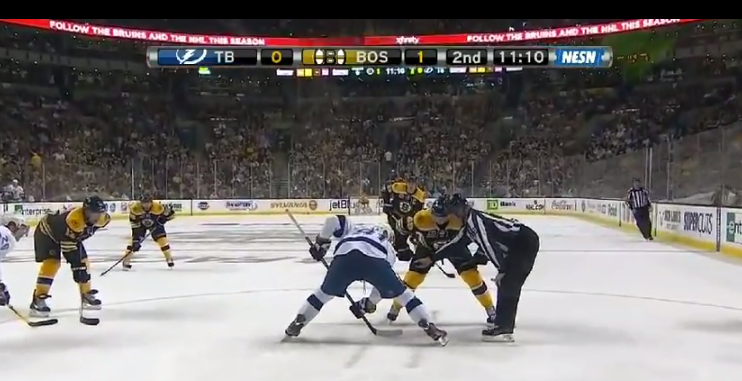
I wrote last week about the Bruins’ struggles following offensive zone faceoff losses. Obviously, Shawn Thornton played a part in that, but a fourth line can only get so much ice time, and obviously there was a bigger issue. When I looked over the numbers from the past few years, it became clear that David Krejci and his linemates, who received a large portion of the offensive zone starts, were hurting the team the most in those situations. Considering Krejci’s new 6 year, $43.5 million contract, and the ongoing debate over whether he or Patrice Bergeron is truly Boston’s number one center, I decided to look briefly (update: not so briefly) at the breakdown of their numbers and where such struggles might be coming from. First of all, here are the numbers.
Controlled Situation Corsi: Shawn Thornton and the Boston Bruins
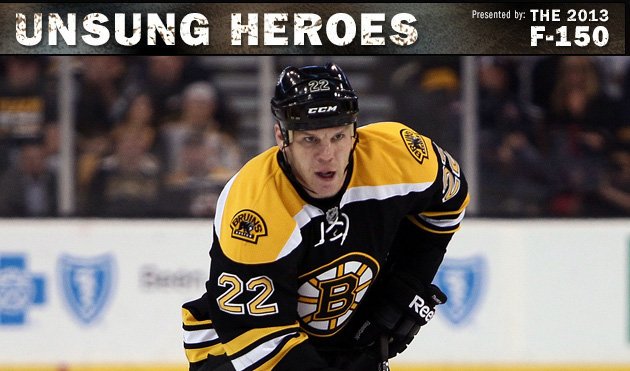
More arguments over the role of character in team sports have been waged than Simpsons episodes watched this past week. Well, maybe not. But every day it seems, a main stream media member churns out a piece on the value that a fourth liner brings to an organization, one supposedly well beyond their pay grade and ice time. Inevitably, bloggers and analysts shoot back about the lack of correlation between toughness and victory, or the impossibility of measuring something like leadership in the grand scheme of the game.
 AP Hockey